
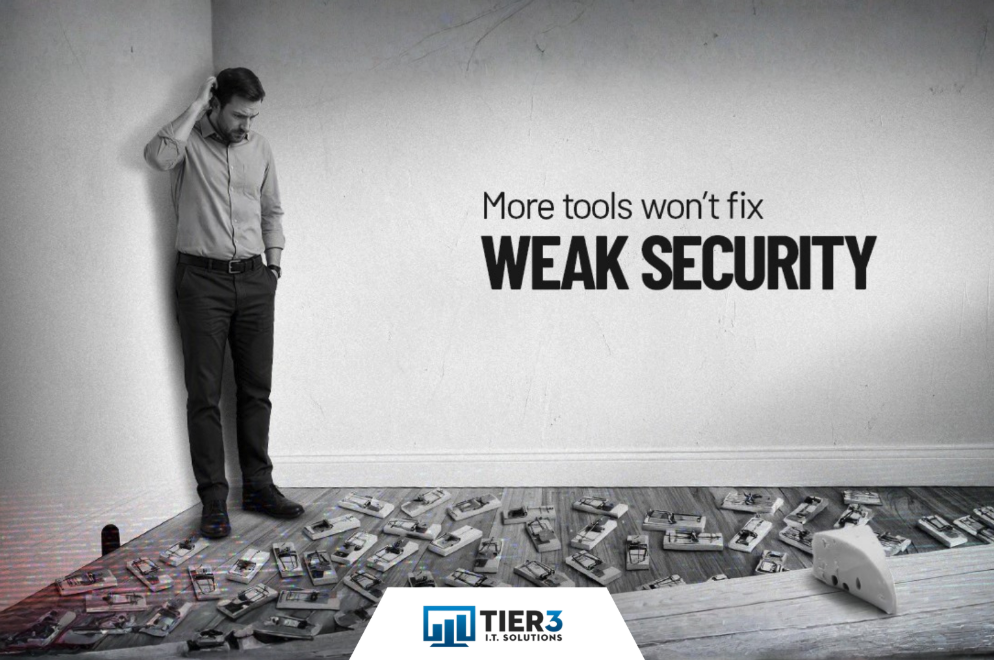
Buying more security tools won’t automatically make your business safer. Too many tools without a clear plan create confusion, overwhelm your team, and waste your budget. If you’re relying on a growing stack of products, you might be missing critical risks instead of reducing them. Let’s look at where your current security approach may be creating unnecessary complexity and how the right managed IT services in Edmonton can help you simplify it.
More Tools Won’t Fix Your Weak Security
Buying another cybersecurity tool can feel like adding more protection for your business. You see a new product that promises to stop threats, and it seems like a smart investment.
The problem starts when those tools pile up without a plan. A stack that once felt reassuring can become hard to manage, easy to misunderstand, and expensive to maintain. As a managed service provider Edmonton businesses trust, we see this pattern regularly.
Before you add another product, let’s look at four ways that too many tools can make security harder than it needs to be.
1. More Tools Create More Complexity
Most crowded security setups start with well-intended decisions. You buy one tool for email security, another for endpoint protection, another for backups, and yet another for access control. Each purchase solves a valid concern.
Months later, you end up with an unexpected problem: Nobody has a comprehensive view of how everything fits together. Your team has to move between dashboards, check separate reports, track renewals, and remember which tool covers which risk.
That slows down security efforts and makes it harder to spot what’s missing. If your team can’t quickly see how your tools support each other, small gaps can stay hidden for too long and cause irreparable damage to your reputation and bottom line.
This is where businesses can benefit from an experienced IT consulting in Edmonton. A clear strategy helps you see which tools actually work together and which ones just add noise.
2. Too Many Alerts Can Hide Real Threats
Alerts help only when someone can read them, rank them, and take action.
When every security tool sends its own notifications, your team is stuck sorting through a constant flow of warnings. Some alerts point to normal activity, some need a quick review, and some signal a real threat. The hard part is knowing which is which before the issue spreads.
That’s where alert fatigue becomes dangerous. People start skimming because the queue never seems to end. A suspicious login, a strange file transfer, or a malware warning can sit too long because it looks like one more item in a crowded list.
The right approach means fewer alerts that are actually useful, not more alerts that get ignored.
3. Overlapping Software Wastes Time and Money
A bloated stack often hides duplicate spending. You may be paying for multiple tools that perform similar functions.
That overlap doesn’t just affect your budget. It also creates extra work for the people managing security. They have to review multiple tools, compare different reports, and decide which product should handle each job.
During an incident, that confusion can cost time. If two tools show different results, your team has to stop and figure out which one to trust before they can move forward.
Working with a trusted IT company in Edmonton can give you a fresh perspective on where you may be paying twice for the same protection. We help identify redundancies and streamline your spending so every dollar goes toward real security.
4. Misconfigured Tools Can Leave Security Gaps
A cybersecurity tool doesn’t protect your business just because you bought it. Someone has to install it correctly, keep it updated, and make sure it’s watching the right people and systems.
This is where businesses quietly lose ground. A security feature gets turned off temporarily during a fix and isn’t turned back on. A tool set up to monitor your original 10 employees may not have been updated to include the 15 you’ve hired since.
None of this shows up on an invoice. The bill gets paid, the tool’s installed, and everything looks fine. The risk isn’t buying the wrong tool. It’s trusting a tool that wasn’t set up properly.
Proactive Managed IT services help ensure your tools are configured correctly from day one and stay that way as your business grows. Regular reviews catch these quiet gaps before they become serious problems.
Strategy Always Beats Quantity
Better security isn’t about buying more software. It’s about ensuring your existing tools are aligned, configured correctly, and support a comprehensive security strategy.
Identify what you need to protect, where attackers could cause the most damage, and which controls already cover those areas. Then decide which tools support that plan and which ones create extra noise.
Think of your security stack like a team. You don’t improve performance by adding more people with unclear roles. You improve it by giving every person a job, removing confusion, and making sure everyone works toward the same goal.
The best stack isn’t the biggest one. It’s the one where every tool has a reason to be included.
This approach is part of what we call business-first technology strategy. We start with your business goals and work backward to the technology that supports them. For businesses across Edmonton, Calgary, Leduc and Grande Prairie, that means less complexity and better protection.
What Good IT Solutions Should Look Like

A well-designed security plan doesn’t require dozens of products. It requires the right products working together under a clear framework.
Here’s what that looks like in practice:
- Centralized visibility: You should be able to see your entire security posture from one place, not five different dashboards.
- Clear ownership: Every tool has a specific job, and someone knows how to use it properly.
- Regular reviews: Your stack gets evaluated at least quarterly to catch configuration drift and remove tools that no longer serve a purpose.
- Proactive monitoring: Alerts are filtered, prioritized, and acted on quickly by people who understand your environment.
This is the foundation of strong cybersecurity. It’s not flashy, but it works.
As a managed service provider in Edmonton, we’ve seen how a simpler approach to cybersecurity can make protection easier to manage. They spend less, respond faster, and sleep better.
How We Help Businesses in Edmonton and Alberta
At Tier 3 IT Solutions, we don’t sell you more tools. We help you make better use of what you already have.
Our team provides managed IT services Edmonton businesses count on to:
- Review your current security stack and identify gaps, overlaps, and misconfigurations
- Build a clear security strategy that aligns with your business goals
- Manage your tools so they stay updated, configured correctly, and working together
- Provide ongoing IT helpdesk support in Edmonton that solves the immediate problem, identifies the root cause and helps prevent it from happening again.
We work with small and medium businesses across Edmonton, Calgary, Leduc, and Grande Prairie. We provide fully outsourced IT services throughout Alberta, giving your business complete IT and cybersecurity support without the need to manage it in-house.
You don’t need to be a technology expert. That’s our job. Your job is running your business. We make sure technology supports that goal instead of getting in the way.
Ready to Simplify Your Security Stack?
If your current setup feels overwhelming, you’re not alone. Many businesses reach a point where their security tools create more work than protection.
We can help you evaluate your security stack, remove unnecessary complexity, and ensure your defenses work together to protect your business.
Book a meeting with our team to see whether your tools are protecting your business or making security harder to manage. We’ll walk through your current setup, answer your questions, and show you what a simpler, stronger approach looks like.
Get started now by reaching out to our team for a free 15 minute consultation. Let’s build a security plan that makes sense for your business, not just your vendor list.
Safeguard your business before it’s too late! Contact us for reliable tech support in Edmonton and a long-term IT strategy designed to prevent problems, strengthen security and keep your business running.
Learn more about how we support businesses like yours at www.tier3it.ca.
The Real Cost of Weak Security
Here’s what most people don’t talk about: The cost of a data breach goes far beyond the immediate fix.
According to a recent IBM report, Canada’s data breach costs hit record highs, with attacks increasingly targeting critical business infrastructure. The financial impact includes lost revenue, legal fees, regulatory fines, and damage to your reputation that can take years to repair.
For small and medium businesses, one serious breach can mean closing your doors. That’s not a scare tactic. It’s a reality we’ve seen too many times.
The good news? Most breaches happen because of preventable mistakes. Misconfigured tools, unpatched software, weak passwords, and gaps in monitoring. These aren’t technical failures. They’re planning failures.
When you work with a trusted MSP Edmonton businesses rely on, you get a partner who watches for those gaps and fixes them before they become problems. That’s the difference between reacting to a crisis and preventing one.
Frequently Asked Questions
Why doesn’t adding more security tools improve protection?
More cybersecurity tools without a clear strategy creates confusion, not safety. When your team can’t see how tools work together or which alerts matter most, real threats slip through. A smaller, well-managed stack catches more problems than a large, disorganized one. Focus on configuring what you have correctly before adding new products.
How do I know if my security tools are misconfigured?
Signs include duplicate alerts from different tools, gaps in coverage for new employees or systems, features that were turned off and never reactivated, and tools that haven’t been updated in months. Regular audits by a qualified IT partner can catch these issues before they turn into breaches.
What’s the best way to reduce alert fatigue in my team?
Start by filtering alerts based on severity and business impact. Turn off notifications for low-risk events that don’t require immediate action. Consolidate alerts into a single dashboard when possible, and assign clear ownership so each alert goes to the right person. Managed IT services can handle this filtering for you.
How often should I review my cybersecurity stack?
At minimum, review your stack quarterly. Check after any major business change, such as adding new employees, opening a new location, or launching a new service. Annual reviews aren’t frequent enough to catch configuration drift or identify tools that no longer serve your needs.
What should I look for in an IT support partner in Edmonton?
Look for a partner who asks about your business goals before recommending tools. They should explain their recommendations in plain language, provide proactive monitoring instead of just break-fix support, and have experience with businesses similar to yours. Check references and ask how they handle after-hours emergencies.